
Sermon by Wally Inglis at St. Elizabeth’s Episcopal Church– Sunday, September 24, 2023
Good morning! … Aloha! ….and welcome to all … as we gather to recall an unforgettable event 40 years ago at Hale Mohalu in Pearl City. For those of us who were there, it seems like only yesterday. Let’s give a warm mahalo to our good friend Father David—he too was there!—for welcoming us to St. Elizabeth’s this morning.

So … here we are, 40 years later. Something about that number “40!” Forty days in the desert for Jesus before he began his ministry … and, long before that, 40 years of desert wandering for the Israelites.
Those of you here last week heard how Moses liberated his people from slavery in Egypt … and led them through the Red Sea. But freedom was nowhere in sight, as we learn from Dawn’s reading of Exodus a few moments ago. Only 15 days out of Egypt, they’ve already been through two deserts. They’re hungry, thirsty … and complaining loudly and often.
Which leads me to our Hale Mohalu story – one chapter in a long history of rejection, banishment and, finally … liberation from leprosy, later known as Hansen’s disease.
Our local version of the Exodus story began in 1866, when the first group was sent into exile on Molokai’s Makanalua Peninsula—arriving in Kalaupapa on January 6 and later settling in Kalawao. There were 12 of them, including a small boy, aboard the ship Warwick.
Their voyage may have lacked the drama of a Red Sea crossing, but at that time of year conditions were pretty rough on the Molokai Channel! Thankfully, it was not a desert that awaited them on the other side. More like an oasis, perhaps.
There, a welcoming community of kama’aina took them in … and gave what comfort they could for fellow Hawaiians who had been taken away from family and friends.
It was almost another century before hope of liberation from their stigmatizing disease appeared … with the discovery of sulfone drugs. In 1946, Promin was introduced at Kalaupapa, an early step to breaking down walls of unneeded separation.
In 1949, negotiations between government agencies resulted in people moving from Kalihi Hospital—which had cared for leprosy patients since 1865—to Hale Mohalu, an abandoned military facility with vacant barracks and other buildings.
In 1956, the federal government agreed to turn the property over to the territorial government at no cost … on condition that it be used as a Hansen’s disease facility for 20 years.
Over time, a tightly-knit community grew and flourished at Hale Mohalu, regarded by all as home … not a hospital. Its residents believed it would remain that way. The state Department of Health, which had allowed the buildings to deteriorate from the outset, had other plans.
In 1978, not long after the 20-year agreement expired, residents were ordered to vacate and move to Leahi Hospital in Kaimuki. Some older, more frail residents reluctantly moved. Others refused! Thus began the epic 5-year struggle we remember and celebrate this morning.
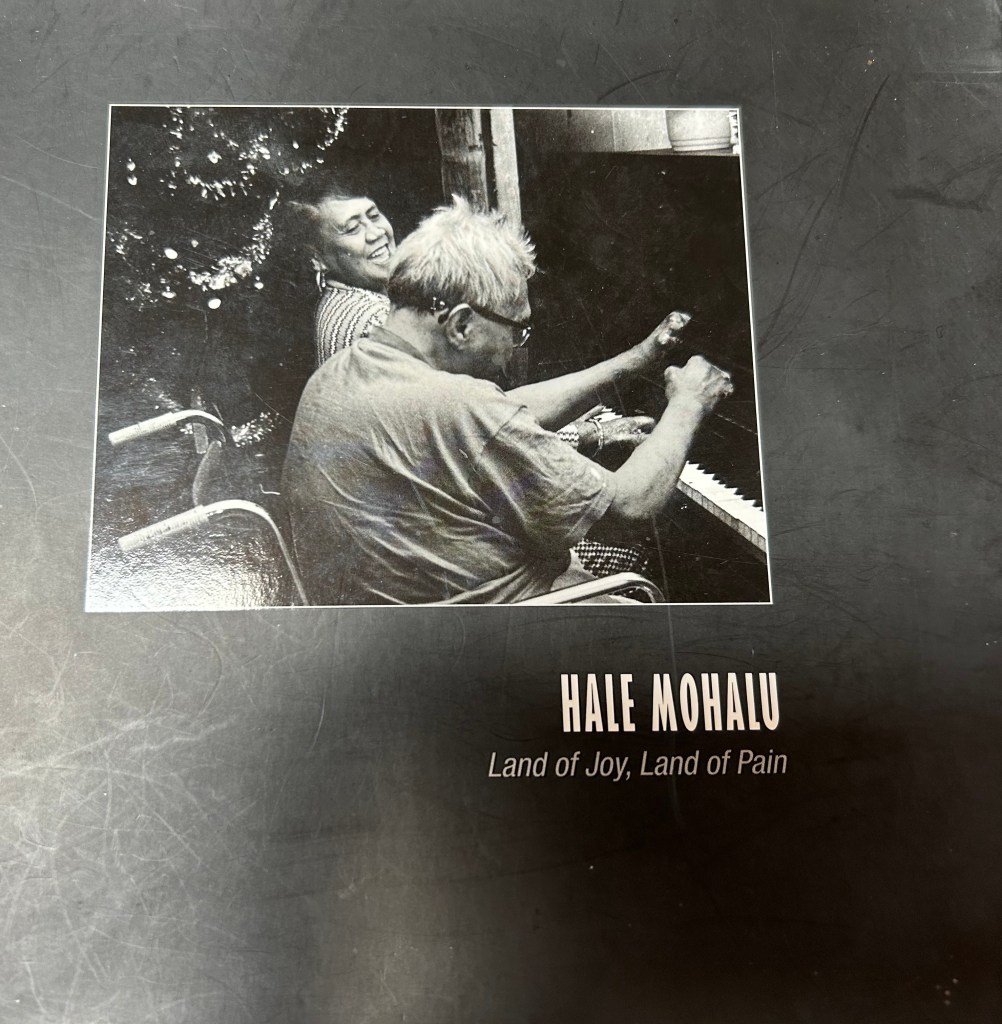
From 1978 to 1983, the small band of resisters lived in difficult, often desperate, conditions. Early on, the state cut off power and water, with residents having to camp out in the darkened buildings. Thanks to Mayor Frank Fasi—who quickly became a champion in the struggle—lights and water were soon restored. But other essential needs—food, medicine, transportation—were lacking. This is where supporters from the wider community stepped in to help.
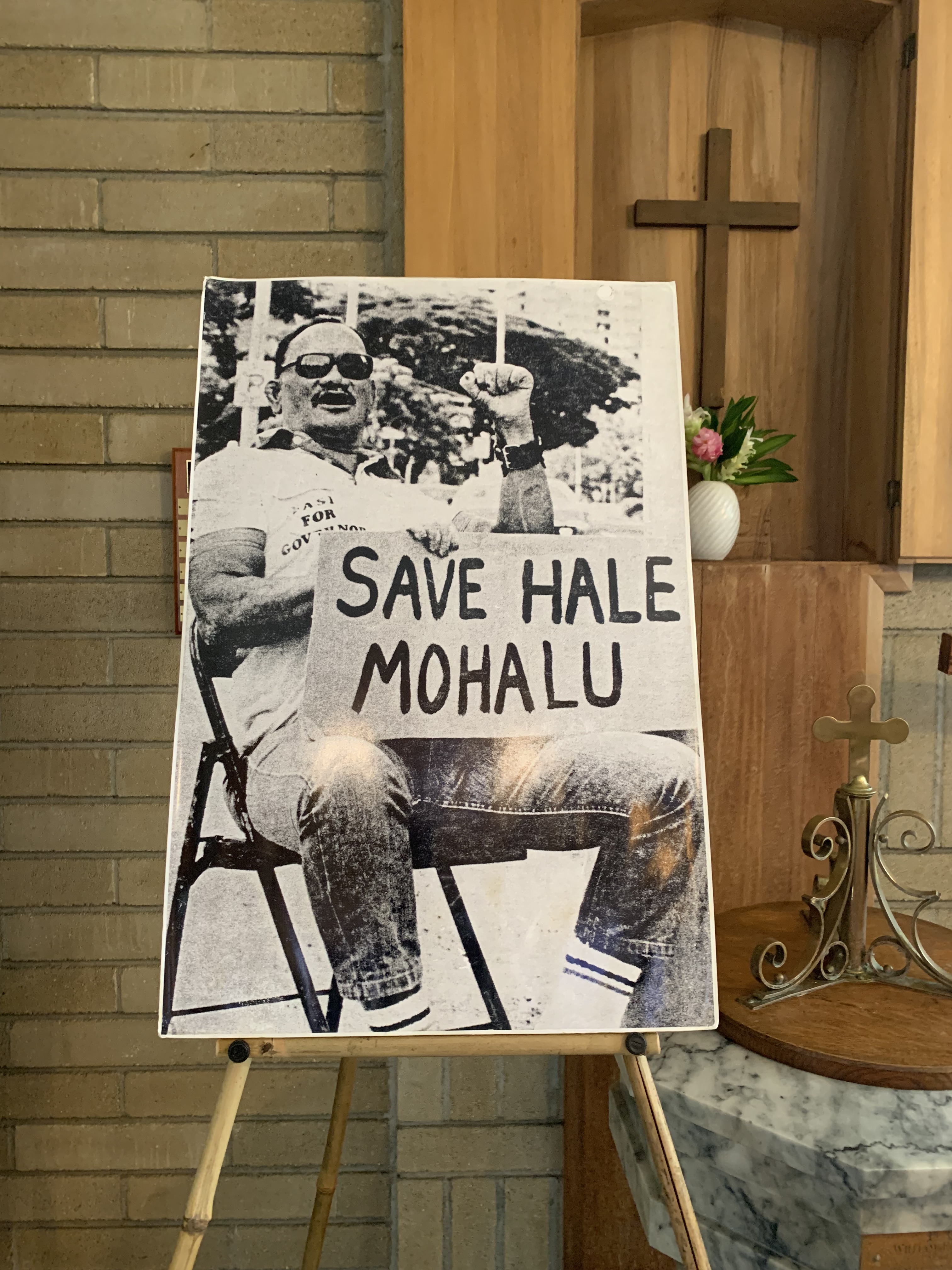
In those days, our friends who had suffered from leprosy were referred to as “patients,” a label hard to shake after decades of accepted use. It was not only condescending … but inaccurate, with overtones of passivity and dependency. From the beginning of the nonviolent resistance at Hale Mohalu, there was no doubt who was in charge—namely, the Hale Mohalu residents themselves …and their chosen leaders, of whom there were several. The public face and voice of this shared leadership was Bernard Punikai’a.
In today’s paradoxical gospel reading, Jesus tells us “The last will be first, and the first last.” Well, the Hale Mohalu folks had their own take on this. Tired of always being “last” – out of sight and out of mind—their claim to an equal place at the table was aptly stated by Bernard who said: “If you’re going to talk about our lives, you damn well better talk to us!” The bureaucrats were not used to this kind of back-talk!
Those speaking out were more than just complainers—the kind Moses and Aaron dealt with in the desert. Theirs was a call to those in power not only to “Save Hale Mohalu,” but to right the many wrongs and injustices inflicted over decades on people with Hansen’s disease.
Their message was delivered to legislators within the state capitol …as well to passers-by on the street, encouraged week after week to “Honk for Hale”—all under the watchful gaze of Father Damien. A delegation even journeyed to Washington to plead its case in the halls of Congress.
But all was not politics, agitation, and rabble-rousing. A joyful fellowship of residents and supporters emerged at Hale Mohalu—gathering on Sunday mornings for worship, music, feasting, and talking story …. just as we are doing this morning. In spite of its tattered condition, Hale Mohalu—true to its name—was a “House of Comfort” for inhabitants and visitors alike.
The community that grew out of shared struggle was a marvel to behold. People were baptized and married at Hale Mohalu. Even funerals were celebrated. Thanksgiving, Christmas and Easter took on deep meaning for our ‘ohana, sensing the unmistakable presence of God in our midst.
But festivity would eventually turn to disruption.
Early in the morning, on September 21, 1983, before dawn, state enforcement officers descended on Hale Mohalu. They ordered both residents and supporters to vacate. Refusal would result in removal and arrest.
Eighteen of our nonviolent resisters were carried away and charged. Bulldozers appeared. By days end our beloved beloved Hale Mohalu was reduced to rubble. The buildings were gone, but the community’s spirit of solidarity was unbroken.
Today’s reading from St. Paul’s letter speaks of a young Christian community under siege. Paul encourages his followers with these words: “Standing firm in one spirit, striving side by side with one mind, and in no way intimidated by your opponents …you are having the same struggle I had.” Philippi 2,000 years ago … and Pearl City just 40 years ago! Similar messages for similar struggles.
Reflecting later on their brave stance, Bernard Punikai’a said: “Hale Mohalu is one of those special times in our history where we collectively took a stand that was unheard of. We dared to say to the administrators: ‘No, you may not do with us as you have been doing with us for the last one 100 years’.” Bernard goes on to hold up Hale Mohalu as a symbol of hope … a quest for dignity, respect, and recognition of our common humanity.
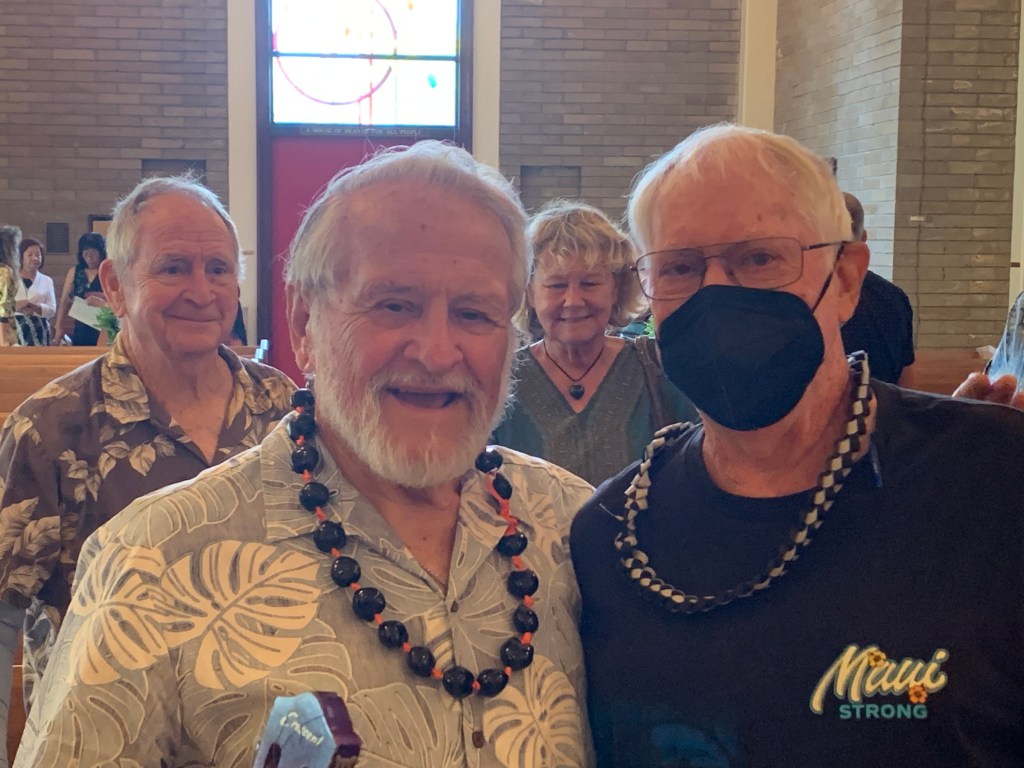
Among those present for the commemorative service were Fr. Gigi Cocquoi (front left), and John Witeck;
Brian Lott, a volunteer at Wallyhouse (back, left), and Valerie Monson, who serves on the Board of Directors of Ka ‘Ohana O Kalaupapa
Daniel Berrigan—priest, poet and peacemaker—was one of many mainland friends who visited Hale Mohalu during the difficult times. Somewhere Dan wrote: KNOW WHERE YOU STAND … AND STAND THERE. The people of Hale Mohalu had no doubt of where THEY stood … On September 23rd, they stood strong around Hale Mohalu’s wooden cross, feet solemnly fixed on holy ground …. giving life and new meaning to the words of a song they sang at so many vigils, rallies and protests: WE SHALL NOT BE MOVED!
Well … they WERE moved … but in body only. Their spirit survived. It lives on in the people who now occupy more than 500 units of low-income housing on the Pearl City land …in buildings that honor the names of Sanford Smith, George Liwai, Frank and Mary Duarte, Clarence Naia, Bernard Punikai’a, Father Damien, and the Kalaupapa ‘Ohana.
Their spirit lives on in ‘ohana members who have served our community as doctors, lawyers, peace activists, farmers, social workers, preachers and teachers, artists, professors, writers, health care providers, labor leaders, workers and volunteers of all kinds, a university president, and, yes …. politicians … some of whom have even made it to Congress and the top floor of our state capitol.
But most of all, their spirit is found in the thousands who lived and died at Kalaupapa and Hale Mohalu. We remember all of them … with great love and affection. Their courage challenged us in ways we would never have imagined. Now, reunited after 40 years, we recommit ourselves to carrying on the legacy of those whose lives we were privileged to share. They are surely with us today …. in this sacred place.
And like them, WE SHALL NOT BE MOVED!
Now you say it … let’s hear it …WE SHALL NOT BE MOVED !!
AMEN
Mahalo nui, Wally, for all you have done and still do–and for permission to blog your wonderful sermon.

 Dawn Morais
Wondrous Wally! A mesmerizing sermon and read! Thank you, sir! (I recall this “window in time” from news coverage back in those days and felt great empathy, but I wasn’t an “active” activist….)
Hi Dawn! Susie Klimkos here from the Dickinson College Fitness Center. I signed up for your Blog posts and I’m finding them very informative. Hope all is well with you and your husband. Keep exercising those knees! 😍
Hi Susie, How nice to know you are following my blog. Working on both knees now–the left one somehow developed a fracture–I guess to outperform the right which has a torn meniscus. It would be funny if it wasn’t so annoying! And getting in the way of my once daily walks. See you before too long.
Good morning Dawn,
I just opened your Email. I often take time to get to my “Road Runner” Email. In the future please use my Gmail address, robinleong@gmail.com. Sorry I missed the event. John told me to check my Email for an upcoming event at last week’s dinner, but he hadn’t given me the details. I was not aware of the date of the event and had not thought about checking my Road Runner Email.
I read Wally’s sermon. I had attended Martha Hennessy’s talk at the Newman Center this past February. Martha is Dorothy Day’s granddaughter. Wally introduced her, giving the opening remarks. I’m glad that you sent me his sermon about Hale Mohalu. It was awesome. A call to action!
Mahalo, Robin
>
I had no idea it was going turn out to be as moving an event as it was, Robin. I should have prompted you. Gail would have enjoyed it too. Brought out long time activists like Jim Albertini and others who have never stopped advocating for justice and peace. Nearly 200 people turned up. Lots of good music from the struggle.